NBI Clearance for OFW: How to Apply From Abroad in 2026
You are working in Riyadh, Singapore, Dubai, or Hong Kong, and your employer just asked for an NBI Clearance. The first realization hits fast: NBI captures fingerprints in person, and you are nowhere near a Philippine branch. The second realization, hopefully, is that this is a solved problem. The NBI has a mail-in process built specifically for overseas Filipino workers, Philippine embassies assist with fingerprinting, and the DFA can apostille the final document so foreign employers accept it.
This page covers every path an OFW can take to get an NBI Clearance in 2026 without losing weeks of leave or burning thousands on a flight home. The embassy fingerprint card method, the special power of attorney route, the timing for apostille, the country-specific quirks, and how seafarers and returning OFWs handle it.
For the standard application process, see our complete application guide. For document requirements, see requirements checklist. For fees, see the fees and payment breakdown. For the renewal flow, see the NBI Clearance renewal guide. To verify a clearance once you have it, see the clearance verification guide.
The Honest Reality: NBI Still Requires Biometrics
Before walking through the methods, set expectations correctly. The NBI Clearance involves three biometric elements: a photo, all ten fingerprints, and a signature. Two of those (photo and digital signature) can only be captured in person at an NBI branch in the Philippines.
What the OFW process does is split the biometrics. Your fingerprints are rolled abroad onto a special form (NBI Form No. 5, also called the “Fingerprint Card”), and those prints are then mailed to NBI in Manila where they are matched against the database. The photo and signature pieces, in practical terms, are filled by your passport photo and the signature on Form No. 5.
This means you can complete the process without flying home. But it also means you cannot skip the fingerprint card step, no embassy will issue you an NBI Clearance over the counter. The clearance always comes from NBI Manila.
Your Three Paths as an OFW
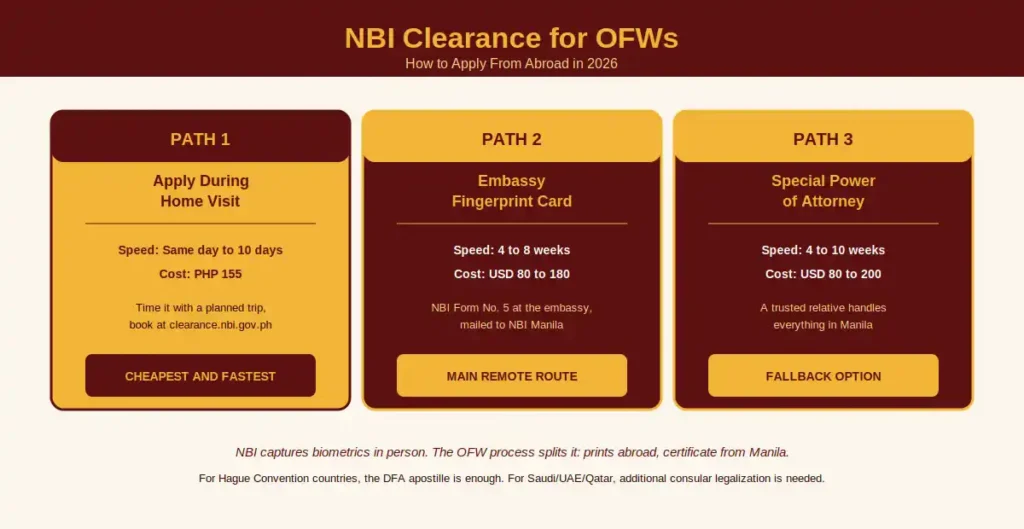
There are three ways to get an NBI Clearance while based abroad. Pick the one that matches your situation:
Path | Best For | Speed | Typical Cost |
|---|---|---|---|
Path 1: Apply during a home visit | OFWs with a planned trip home | Same day to 10 days | PHP 155 plus optional delivery |
Path 2: Embassy fingerprint card (mail-in) | OFWs who cannot travel home | 4 to 8 weeks total | PHP 155 plus apostille plus courier |
Path 3: Special Power of Attorney filing | Countries without convenient embassy fingerprinting | 4 to 10 weeks total | PHP 155 plus apostille plus courier plus SPA notarization |
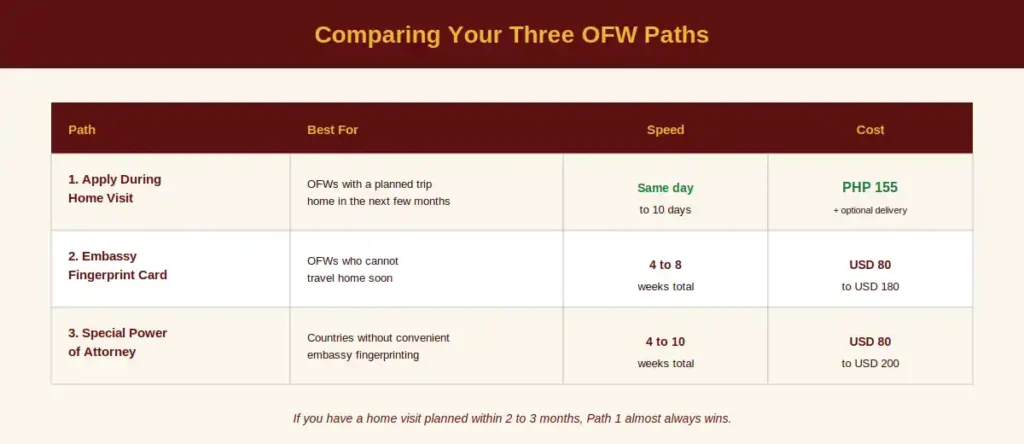
The cheapest, fastest, and most reliable path is Path 1. Use Path 2 when you cannot reasonably travel home in the next two to three months. Use Path 3 only when neither of the first two is available.
Path 1: Apply During Your Home Visit (Fastest Route)
If you have a planned trip home in the next few months, time your application around it. The standard portal booking applies to you exactly as it would to a domestic applicant.
How to Schedule Around Your Trip Home
- Confirm your travel dates and pick an NBI branch near where you will be staying.
- Book the appointment online at clearance.nbi.gov.ph as soon as your trip is firm. Slots open weekly, popular branches fill within hours.
- Pay the PHP 155 through GCash, Maya, or any accepted channel.
- Attend the appointment in person on your scheduled date.
- Collect same day if possible, otherwise return in 5 to 10 working days or have it delivered to a relative’s address.
For the full booking flow, see [LINK: appointment-page]. For specific document requirements, see [LINK: requirements-page].
What to Bring as an Overseas-Based Filipino
- Philippine passport (the strongest ID and the one most often required for OFW applications)
- Second valid government ID (UMID, driver’s license, voter’s ID, etc.)
- OWWA ID or iDOLE card if you have one
- Employment contract or job offer if NBI or your employer requests it
- Printed appointment slip and payment receipt
Timing Tips
- Apply in the first week of your home visit so you have time to handle a HIT if your name gets flagged.
- Avoid applying on your last day, you may not collect the clearance before flying back.
- If your visit is brief, book at a branch with same-day release like the main office at UN Avenue, or any provincial branch where queues are light.
If a HIT delays your release past your return flight, NBI can ship the cleared document to a Philippine address (a relative, a courier holding office), and you can have it apostilled and forwarded later.
Path 2: Embassy Fingerprint Card Method (The Main Remote Route)
When you cannot fly home, the embassy fingerprint card method is the primary remote path. Every Philippine embassy and consulate worldwide assists with this process, though the exact procedure varies slightly by post.
What You Need
- NBI Form No. 5 (the Fingerprint Card, also called “sundry”), legal-size 8.5 by 13 inches, printed in colour
- Two passport-size photos (2×2 inches, white background, recent)
- Valid Philippine passport (original plus a photocopy of the bio page)
- Proof of residence abroad (resident permit, work visa, utility bill)
- Payment for the embassy service fee (varies, typically USD 20 to USD 25 in many posts)
- An attorney-in-fact in the Philippines OR a self-shipping arrangement to send the completed form to NBI Manila
Step-by-Step Process
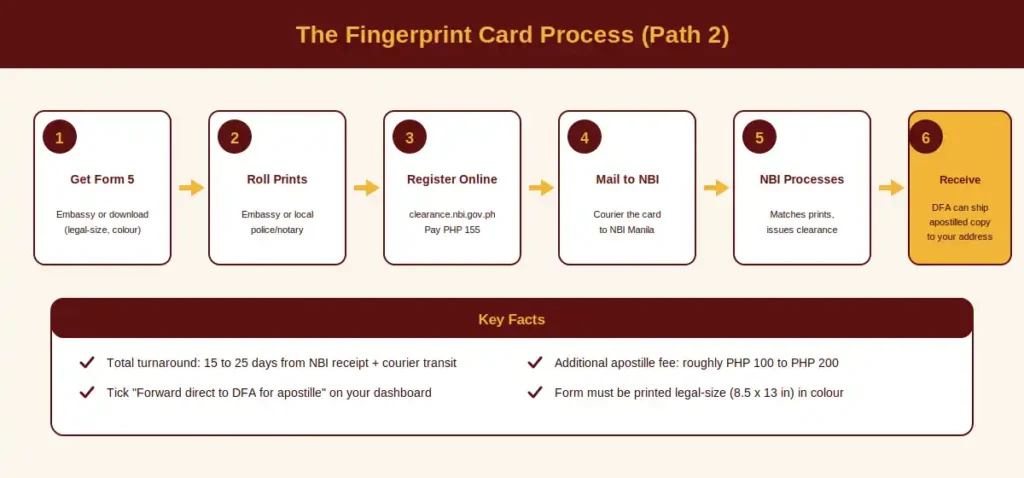
Step 1: Obtain NBI Form No. 5
You have two options:
- Pick it up at the nearest Philippine Embassy or Consulate during business hours.
- Download the PDF from the NBI website or your embassy’s site and print it on legal-size paper (8.5 x 13 in) in colour. Do not resize it, fingerprint scanners need the original dimensions.
Step 2: Have Your Fingerprints Rolled
The fingerprints must be taken by a qualified person. Two options:
- At the Philippine Embassy or Consulate. Book an appointment online. A consular officer rolls your prints onto Form No. 5 and applies the consular seal and signature. This is the most accepted version.
- At a local police station or notary public. A local police officer or notary rolls your prints in black ink only. They must add their stamp, name, designation, and signature to the “Sundry Information” section of the form. The form is then accepted by NBI Manila as valid.
Step 3: Register Online and Pay the Fee
- Go to clearance.nbi.gov.ph and register or log in.
- Complete the application form with details exactly matching your passport.
- Select the purpose (most OFWs choose “employment abroad” or “visa application”).
- Pay the standard PHP 155 fee through GCash, Maya, online banking, or any accepted channel.
- Tick the “Forward direct to DFA for apostille” option on your dashboard if your destination country requires it. The additional apostille fee (around PHP 200) is paid through the same reference number.
- Save your NBI Reference Number (NRN), this is critical.
Step 4: Mail or Hand-Deliver the Fingerprint Card to NBI Manila
You have two options:
- Mail it through a reliable courier (DHL, FedEx, LBC International, or your country’s postal service). Include your NRN clearly on the package.
- Send it through an attorney-in-fact, usually a relative in the Philippines who hand-delivers the form to NBI for faster processing.
Mailing address: NBI Clearance Mailing Section, NBI Headquarters, Taft Avenue, Ermita, Manila.
Step 5: NBI Processes and (Optionally) Forwards to DFA
Once NBI receives your fingerprint card:
- They match your prints against the database
- If no HIT, your clearance is printed within several working days
- If you ticked the apostille option, NBI forwards the printed clearance directly to DFA
- DFA applies the apostille and (in many cases) ships it directly to your foreign address
Step 6: Receive the Clearance
Depending on your selections:
- NBI ships to a Philippine address (a relative’s home or a courier holding office) for you to forward yourself
- DFA ships directly to your foreign address if you used the apostille forwarding option
- You collect it on a future home visit
The total turnaround is 15 to 25 calendar days from NBI’s receipt of documents, plus international courier transit time.
Path 3: Special Power of Attorney (Attorney-in-Fact) Filing
Some countries do not have a convenient Philippine embassy fingerprint service, or applicants prefer to have a relative handle the whole process in Manila. The traditional way is to appoint an Attorney-in-Fact through a Special Power of Attorney (SPA).
When to Use This Path
- You are in a country without an embassy that offers fingerprint facilitation
- You want a relative in the Philippines to handle the legwork
- Your destination requires a clearance type that involves DFA visits the SPA holder can do for you
- You have urgent deadlines and a trustworthy attorney-in-fact already
How It Works
- Draft and notarize a Special Power of Attorney appointing a specific relative or representative in the Philippines. The SPA must be notarized at the Philippine Embassy or Consulate (or notarized locally and then apostilled).
- Have your fingerprints rolled at the embassy or by a local police officer on NBI Form No. 5.
- Send the SPA, the fingerprint card, copies of your passport and IDs, and the application details to your attorney-in-fact in the Philippines.
- The attorney-in-fact files the application at any NBI branch using your fingerprint card and the SPA.
- The attorney-in-fact pays the fee through their own channel using your reference number.
- NBI processes the clearance, the SPA holder collects it.
- The SPA holder brings the clearance to DFA for apostille if required by your destination country.
- The SPA holder ships the apostilled clearance to you abroad via courier.
This path is more involved but it lets a trusted relative handle everything in Manila while you continue working abroad.
DFA Apostille: When You Need It and How to Add It
The NBI Clearance, on its own, is a Philippine government document. For it to be recognized by a foreign government, employer, or institution, it usually needs an apostille from the Department of Foreign Affairs (DFA).
What an Apostille Is
An apostille is an internationally recognized certification that authenticates the origin of a public document. It confirms that the NBI Clearance was genuinely issued by the Philippine government. Once apostilled, the clearance is accepted in any of the 120+ countries that are party to the Hague Apostille Convention.
How Much It Costs
- Regular apostille: approximately PHP 100 to PHP 200
- Express or rush apostille: approximately PHP 200 to PHP 500 depending on service level
If you tick “Forward direct to DFA for apostille” in your NBI dashboard, the fee is paid through the same NRN via GCash or BancNet.
The Streamlined Apostille Forwarding Option
In 2026, the NBI offers an integrated apostille service for OFWs:
- Tick “Forward direct to DFA for apostille” in your e-Clearance dashboard before shipping the fingerprint card
- Pay the additional apostille fee through the same NRN
- NBI prints your clearance and endorses it directly to DFA
- DFA applies the apostille
- DFA ships the apostilled clearance to your foreign address (or to a Philippine address you specified)
This eliminates the need for someone to physically walk the clearance from NBI to DFA. Turnaround is around 15 to 25 calendar days from NBI’s receipt of your documents, plus international courier transit.
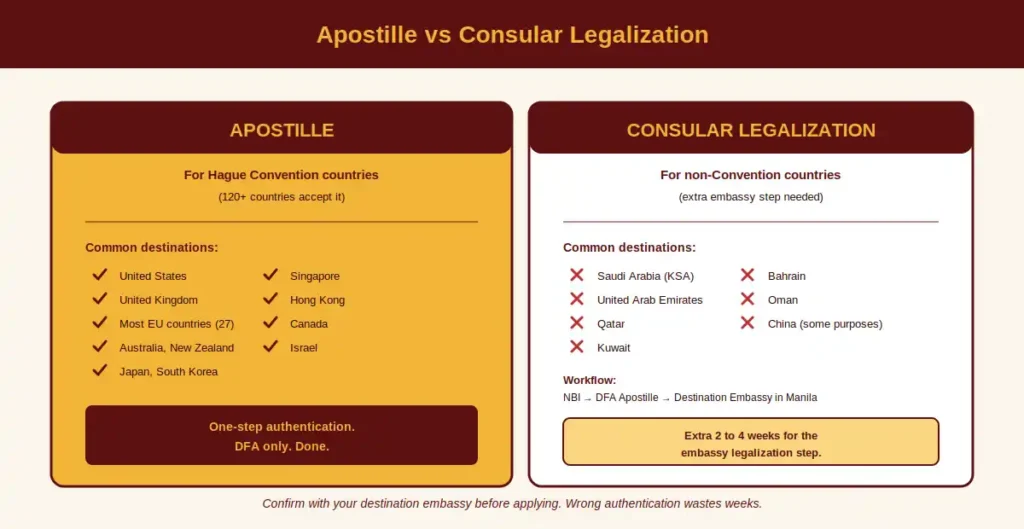
Apostille vs Consular Legalization
Not every country accepts apostille. Knowing which applies to your destination saves you weeks of rework.
Apostille Countries (Hague Convention Members)
The DFA apostille is sufficient on its own. No further authentication needed. Common OFW destinations in this group include:
- United States (federal acceptance, though some states/employers have additional rules)
- United Kingdom
- Most European Union countries (Germany, France, Italy, Spain, Netherlands, etc.)
- Australia and New Zealand
- Japan
- South Korea
- Israel
- Hong Kong (as a separate party)
- Singapore
Non-Apostille Countries (Require Consular Legalization)
The DFA apostille is the first step, but the document then needs additional authentication at the destination country’s embassy in the Philippines. Common OFW destinations in this group:
- Saudi Arabia (KSA Embassy legalization required)
- United Arab Emirates
- Qatar
- Kuwait
- Bahrain
- Oman
- China (for some purposes)
For these destinations, the workflow is:
- NBI issues the clearance
- DFA authenticates it (apostille or “red ribbon” depending on year)
- The destination country’s embassy in Manila applies their consular legalization
This third step usually requires the attorney-in-fact path because foreign embassies in Manila typically handle documents in person. Always check the latest requirement with your specific destination’s embassy.
Embassy One-Stop Outreach Events
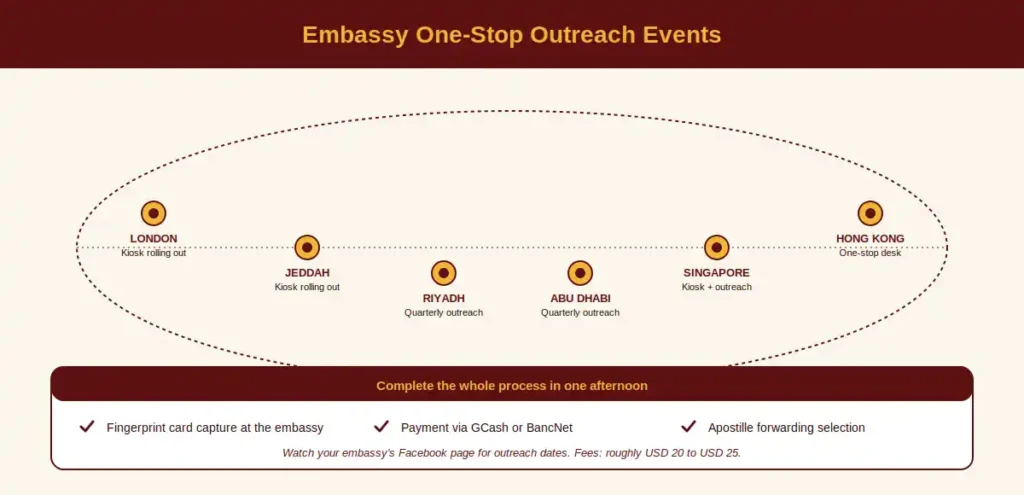
Several major Philippine embassies in OFW-heavy regions run quarterly “one-stop NBI and apostille” outreach desks. These events let you complete the fingerprint card, payment, and even the apostille forwarding in a single visit. As of 2026, embassies known to run these include:
- Riyadh, Saudi Arabia
- Abu Dhabi, United Arab Emirates
- Hong Kong
- Singapore (Self-Service Apostille Kiosk rolling out)
- Jeddah, Saudi Arabia (Self-Service Apostille Kiosk rolling out)
- London, United Kingdom (Self-Service Apostille Kiosk rolling out)
Fees at outreach events are slightly higher (around USD 20 to USD 25 for the embassy service) but you save international courier costs and the back-and-forth of mailing.
How to find out about outreach in your country:
- Check your local Philippine Embassy or Consulate Facebook page
- Sign up for the embassy’s email newsletter if available
- Watch for advisories during peak deployment seasons (typically January, April, July, October)
If your embassy runs one of these events, prioritize attending. You can finish the entire OFW NBI process in one afternoon.
For Seafarers: NBI Plus MARINA Documents
Seafarers face a slightly different set of requirements because maritime employment involves both NBI and MARINA documentation.
Standard Seafarer Documents
- NBI Clearance (same PHP 155 fee, same process)
- Seafarers’ Identification and Record Book (SIRB) issued by MARINA
- Seafarers’ Registration Certificate (SRC)
- Medical certificate from a DOH-accredited clinic
- Training certificates required by your role (STCW, BST, etc.)
Application Tips for Seafarers
- Coordinate with your manning agency for the exact document set, requirements change by flag state
- Apply for the NBI Clearance with at least 60 days lead time before contract signing or boarding
- Specify “Travel Abroad” or “Overseas Employment” as the purpose in your NBI application
- Apostille is usually required for foreign-flagged vessels, confirm with the agency
For seafarers based in Manila or Cavite, the standard portal booking is fine. For those already deployed and needing renewal, the embassy fingerprint card method (Path 2) is the way to go.
Returning OFWs: Renew or Reapply?
If you are coming home permanently or on an extended break, your NBI Clearance status depends on whether your current clearance is still valid:
- Still valid (within one year of issue): No action needed unless an employer asks for a fresh copy
Expired or about to expire: File a renewal application. The renewal process is faster because the system already has your record. See [LINK: renewal-page] for the full renewal walkthrough.
Never had an NBI Clearance: Apply as a first-time applicant. See [LINK: homepage] for the new application walkthrough.
A common mistake among returning OFWs is assuming an old clearance from a previous deployment is still valid. The one-year validity rule applies strictly. If yours is older than 12 months, treat it as expired and renew.
Timeline Planning for OFWs
Plan backward from your deadline. Here is a realistic breakdown:
Step | Estimated Time |
|---|---|
Embassy appointment booking | 1 to 4 weeks ahead |
Fingerprint card capture at embassy | 1 day |
International courier to Manila | 3 to 10 days |
NBI processing | 5 to 15 working days |
DFA apostille (if selected) | 3 to 7 working days |
Return international courier | 3 to 10 days |
Total realistic turnaround | 6 to 10 weeks |
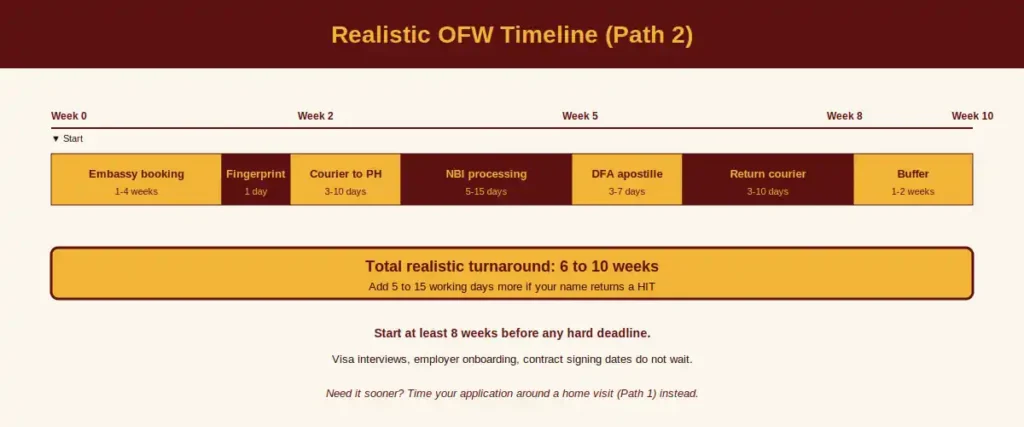
If you have a hard deadline (visa interview, employer onboarding date), start the process at least 8 weeks before. Add buffer for HIT verification, which can add another 5 to 15 working days.
Costs Breakdown for OFW Applications
Compared to a standard domestic application, OFW costs add up. Plan accordingly:
Cost Component | Approximate Amount |
|---|---|
NBI Clearance fee | PHP 155 |
DFA apostille fee | PHP 100 to PHP 200 |
Embassy service fee (per visit) | USD 20 to USD 25 |
Notarization of SPA (if used) | USD 10 to USD 30 |
International courier to Manila | USD 20 to USD 50 |
International courier return | USD 20 to USD 50 |
Optional: courier within Philippines | PHP 200 to PHP 300 |
Estimated total for full remote process | USD 80 to USD 180 |
The home-visit path (Path 1) costs only PHP 155 plus optional delivery, far cheaper than the remote routes. If you have a trip home in the next two to three months, that path almost always wins.
Common OFW Pitfalls and How to Avoid Them
Pitfall 1: Name Mismatch With Passport
The NBI cross-references Philippine civil registry data. If the name on your application differs from your passport (even by a middle initial or a Jr/Sr suffix), you risk a HIT or rejection.
Fix: Use your name exactly as it appears on your Philippine passport. Bring your PSA marriage certificate if you have changed your surname.
Pitfall 2: Letting the Clearance Expire Abroad
OFWs often discover the one-year validity rule only when an employer asks for a fresh copy and the existing clearance is 13 months old.
Fix: Diary the expiry date. Start a renewal 60 to 90 days before expiry to avoid gaps.
Pitfall 3: Skipping the Apostille and Submitting a Plain Clearance
Some OFWs submit the bare NBI Clearance to a foreign employer and get it rejected for “lack of authentication.”
Fix: Confirm with your employer or embassy whether they need a plain clearance, an apostilled one, or a consular-legalized one before applying. Do not assume.
Pitfall 4: Using a Foreign Passport on the Application
If you have dual citizenship and register with a non-Philippine passport, the system may not match your records.
Fix: Always use your Philippine passport for the application, even if you have other citizenship.
Pitfall 5: Booking a Home-Visit Appointment Too Late
Applicants who book on the last day of their home visit often miss collection.
Fix: Book within the first week of arrival. Same-day release is possible at many branches if you arrive early and have no HIT.
Pitfall 6: Losing the NBI Reference Number
The reference number (NRN) is what links your fingerprint card to your application. Lose it and the package cannot be matched at NBI Manila.
Fix: Save the NRN in at least three places: email, screenshot, and a printed copy. Include it visibly on the courier envelope.
Pitfall 7: Sending a Resized or Photocopied Form
Form No. 5 must be on legal-size paper (8.5 x 13 in), in colour, with original prints rolled by hand. Photocopied or resized forms get rejected.
Fix: Print Form No. 5 fresh in legal size, or get a clean copy at the embassy.
Country-Specific Quick Notes
A short guide for the most common OFW destinations. Always confirm the latest with your embassy.
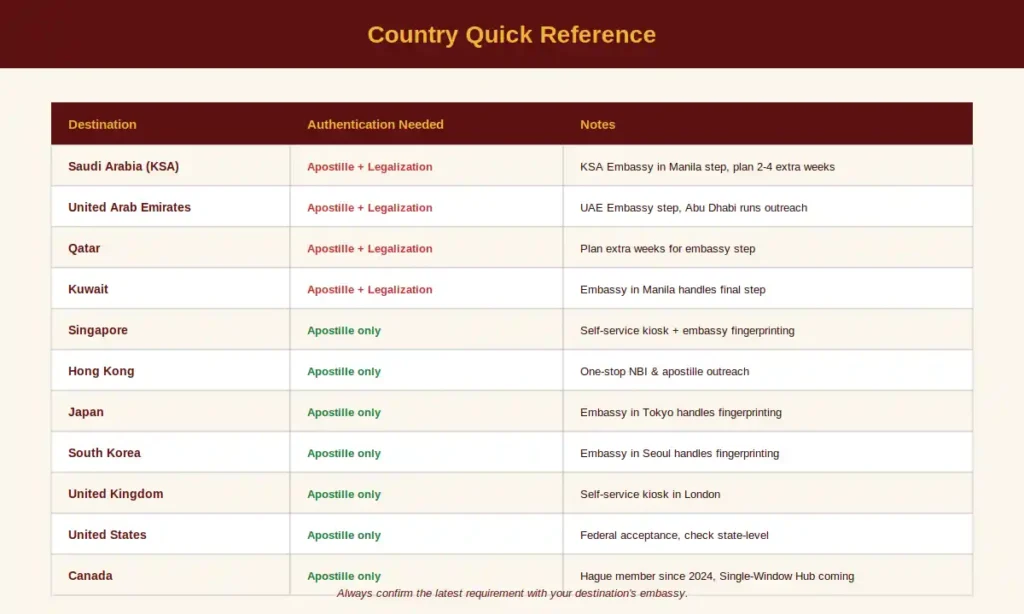
Saudi Arabia (KSA)
- Apostille required PLUS Saudi Embassy legalization in Manila
- Embassy in Riyadh runs periodic outreach desks
- Allow extra 2 to 4 weeks for KSA embassy legalization step
- Common for new deployments and contract renewals
United Arab Emirates (UAE)
- Apostille required PLUS UAE Embassy legalization in Manila
- Embassy in Abu Dhabi runs outreach events
- Watch for “MOFA attestation” requirement from some UAE employers
Singapore
- Apostille sufficient (Hague Convention member)
- Embassy in Singapore offers fingerprinting and self-service apostille kiosk
- Among the smoothest jurisdictions for OFWs
Hong Kong
- Apostille sufficient
- Consulate in Hong Kong runs one-stop NBI and apostille outreach
- Strong infrastructure for domestic helpers and skilled workers
Japan
- Apostille sufficient
- Embassy in Tokyo handles fingerprinting
- Visa interviews often require recent (under 6 months) clearance
South Korea
- Apostille sufficient
- Embassy in Seoul handles fingerprinting
United Kingdom
- Apostille sufficient
- Embassy in London runs self-service apostille kiosk
- Used heavily by NHS nurses and care workers
United States
- Apostille sufficient at federal level
- Some state employers or licensing boards may require additional certification
- Common for immigrant visa applications (CR-1, IR-1, K-1, etc.)
Canada
- Apostille sufficient (Hague Convention member since 2024)
- The new Single-Window Police Clearance Hub (PNP + NBI) being piloted for Canadian applications in 2026
- Used heavily by Express Entry and PNP applicants
European Union (Schengen)
- Apostille sufficient for all 27 member states
- Used for work permits, student visas, family reunification